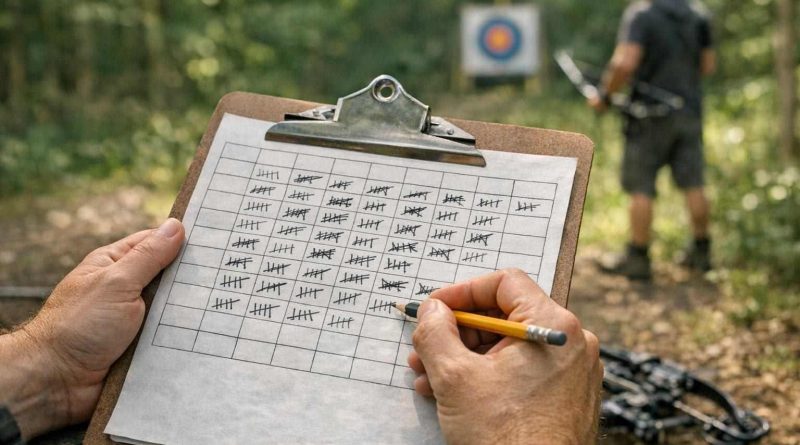
Keeping Score at a Field Archery Round Without Losing Your Place
In field archery the shooter has to keep a number of things in his head when he is shooting. In addition to keeping track of which target he is shooting at, he has to keep count of how many arrows he has shot, where he has placed his feet on the shooting line, how he shot the arrow (e.g. with bow arm relaxed or tense) and last but not least, he has to fill in a scorecard. And if an archer forgets to enter a score or gets a mark wrong it is often not possible to look up the correct score later.
Set up the scorecard before the first arrow
You should discuss how you will be recording scores before you begin the round. In the case of a larger group it is a good idea to rotate the task of recording the scores throughout the round. This will help to keep everyone involved throughout the round.
Writing must be legible – even when wet, muddy, or covered in shake. Using a clipboard, notebook or other flat surface to store the score card at all times prevents it from folding over.
Before your first shot fill in the information that we use to identify the round that you are shooting as well as the name of each archer on your team. Make sure to leave enough room for the individual arrow scores, as well as the subtotal for each target, and for any corrections that may be needed. Make sure that if your scorecards are set up to have separate sections for different distances, faces, etc. that you use these instead of trying to "squsuee" all of the information for a given target into a single running total.
A running total is fine, but do not rely on it to cross check the scorecard later. If the total is wrong then it is only the individual arrow scores that will enable you to work out where things went wrong.
Choose a scoring method everyone can read
Another simple rule: Remember the scoring rules for the round in play, whether as outlined on the scoring card, in the event rules or on the Range Briefing notes. Scoring rules can change so ensure you are using the most up-to-date official version for the event you are attending.
When recording the score on your field archery scorecard a practical card would have columns for each archer and record their individual scores in the order that you shot at the targets. Use the same order for the targets at each distance and make sure to record the score for each face of the target in the same order.
Record arrow values for a target before you work out the subtotal for them. Recording the values for a target in the scorekeeper's notebook before working out the subtotal allows the group to verify the values before they are forgotten as the shooter moves on to the next target. Also it is less likely to be skipped when writing out the totals for the arrows.
So long as you do use a line through the mark to indicate that it has been crossed out, it does not matter how the line is made (e.g. scratching out, cutting out and taping over, etc.) nor where the new mark is in relation to the original. It is also worth noting that some rounds require the scorer to note who made the change as well as when it was made.
Call the scores clearly and mark them immediately
Insist that the group and archers follow the simple rule: Inspect the target, announce the arrow score, ask if the score keeper got it right, record the score and then move on to the next target. Do not try to score, pack up your equipment and walk away to the next target all at the same time.
The archer or group member calls the value of the arrow (e.g. "2" for a 2 point arrow). The scorekeeper repeats this and writes the values on the card (scorekeeper: "2", archer confirms: "yes, 2 points"). If necessary, the value can be repeated again by the archer to make sure the scorekeeper has written it correctly.
The card should be kept in the same position throughout the round. This means that the card should not be held upside down, or passed from hand to hand. Inevitably, scores will be entered in the wrong place if the card is re-arranged each time the group moves to a new target. Marks should be made on the target in the same place as the target number before the scores are written on the card. This is particularly important when targets look very similar and are being moved around while scoring.
Don't go and write down your memory of a score at the next target – if in doubt about a score at a previous target, go back and sort it out there and then. It may cause a temporary delay but it's far better to be sure of a score than to risk getting it wrong and having to re-score the whole group later.
Handle doubtful arrows without rushing the call
For close arrows it's important to have a process which allows for time to consider the score. Therefore, do not move arrows or make assumptions about scores which have been shot but not written down. Allow people who have looked at the arrow from suitable angles to come to a decision on the score. Follow the event procedure if there is disagreement over a score. If using the official event judges then follow the rules for appeal.
If a score is subsequently changed after it has been recorded, the original score must still remain clearly visible on the scorekeeper's card. All such changes must be recorded on the card as well as noted by the scorekeeper. The official judge's decision or the event's official appeal procedure should be used to settle close calls rather than allowing the matter to be decided by the group.
Missing arrows can be the same problem as reading arrows out of sequence. Avoid guessing for the sake of finishing early. A short delay at the target to re-archer an arrow to be scored is far worse than having to re-score several targets down the range.
Even more important is to stay behind the shooting line or waiting position until the group has left the shooting station, as agreed upon by the group in the range briefing. Scorekeeping does not require you to rush past an archer who is preparing to shoot.
Check the card before leaving each station
If in doubt at the end of the round check the card for every archer for correct target number, scores in correct columns, correct total for that column, and overall card total. Watch for signs of simple errors (as listed above). Eventually add up all totals and compare to card entries. If possible have someone else add up totals as well.
Look for obvious errors. The same total in two different columns of a card, a missing target number, an unusual space between lines, or a sudden change in handwriting all need to be checked while the target is still out and the shots can be verified.
At the end of the round add up all the totals, check them against the card entries for each target. Better still have someone else to add up the totals for you. Keep the original score card(s) intact with all the corrections made along the way including any notes made.
There is nothing special about a scorekeeping routine. It should ensure that all arrows are recorded, that any errors are recorded too, and enable others to get on with their own activities safely. It is then a simple matter to check the totals against the individual scorecards.